GPS time clock
A GPS time clock that says where the punch happened
A GPS time clock is a clock-in app that records where a punch was made as well as when. Staff clock in on their own phone and the punch stores the coordinates the phone reported at that moment. Draw a fence around a site, anywhere from 20 to 5,000 metres, and each phone punch records whether it landed inside it and how many metres out it was if not. Punches made with no signal keep the time they were tapped. The time clock itself is free for up to 10 people, and the GPS location stamp starts on the Starter plan.
No credit card required. Free plan for up to 10 people.
Updated July 2026
01
The stamp belongs to the punch
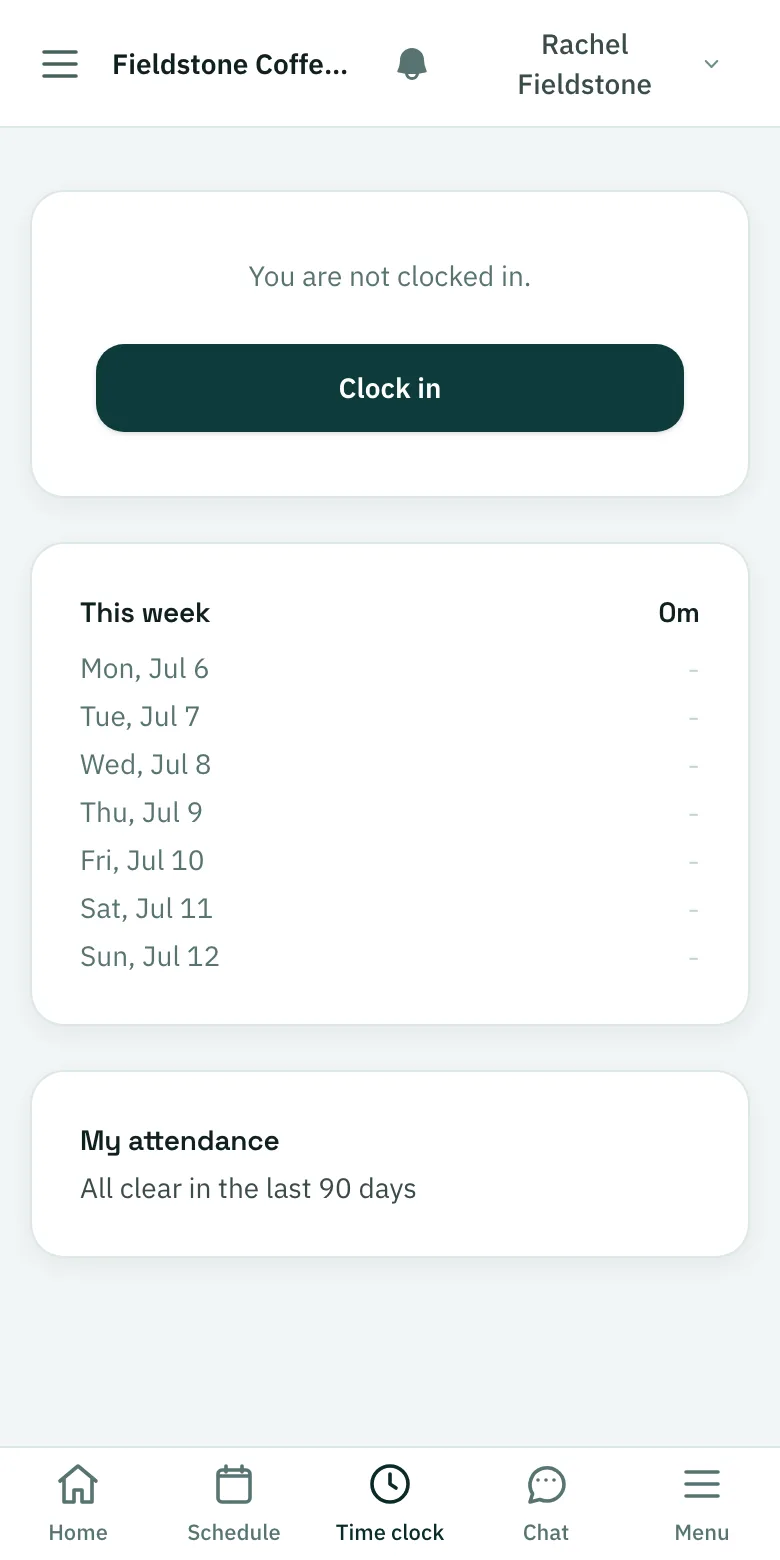
Every clock-in and clock-out stores the coordinates the phone reported at that moment, next to the time. Location is read when somebody punches, once on the way in and once on the way out, and the two directions are separate switches: a site that wants a stamp on arrival and nothing on the way out can have exactly that.
02
Draw a fence, get the distance in metres
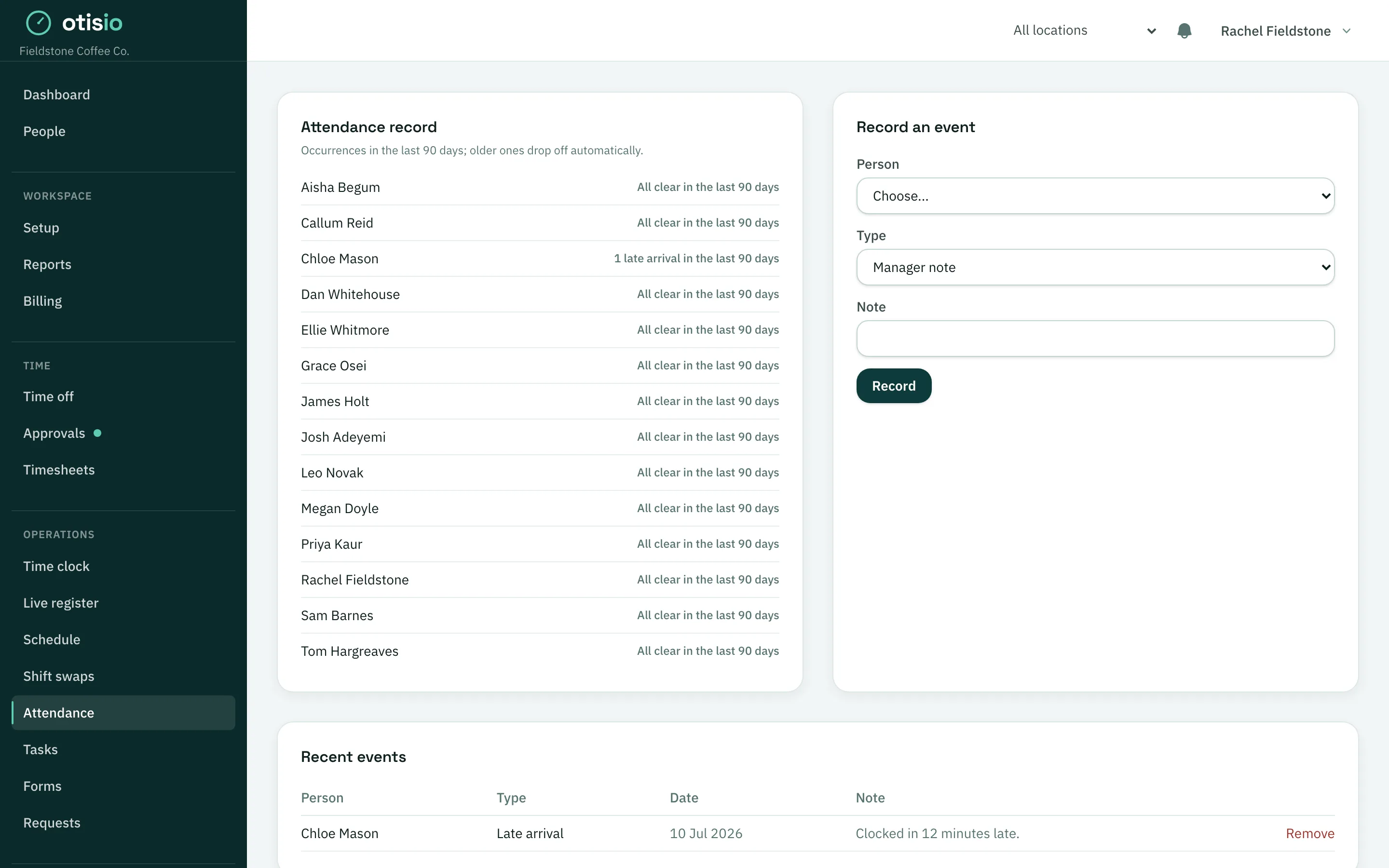
Give a site a centre point on a map and a radius between 20 and 5,000 metres. Each phone punch is measured against it and the result is stored on the punch: inside, or this many metres outside. A manager reads "340 m from the site" rather than forming an opinion. Geofencing comes with the Pro plan.
03
Flag it, or refuse it, site by site
By default an out-of-radius punch is recorded and marked rather than blocked, because refusing a punch only manufactures a wrong timesheet and an argument about pay. Where one site needs the harder rule, switch enforcement on for that site alone and an out-of-radius punch is refused with the distance in the message. A punch that arrives with no usable location at a fenced site has its own per-site setting: allow it, flag it for review, or refuse it.
04
The flag arrives while the shift is still running
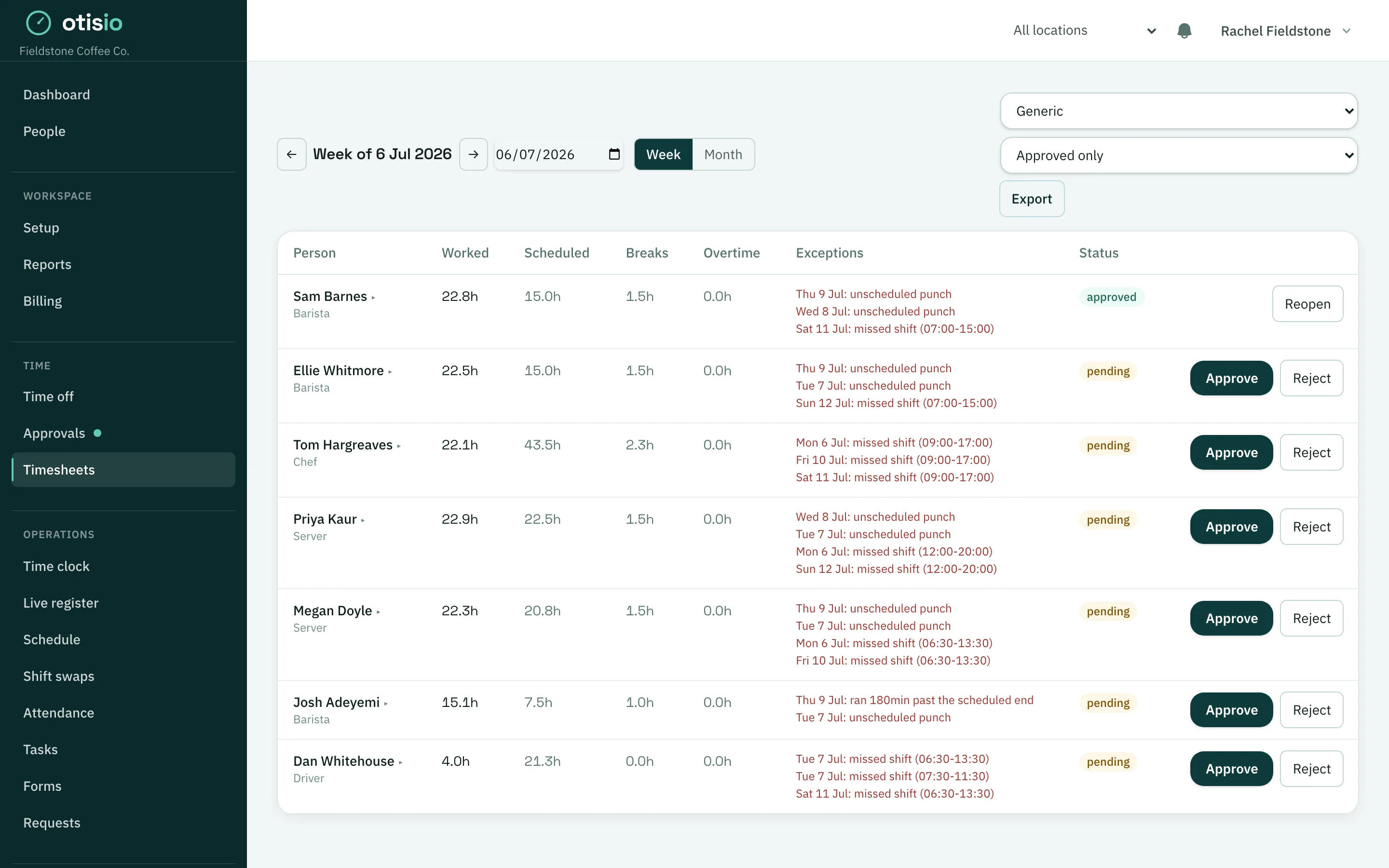
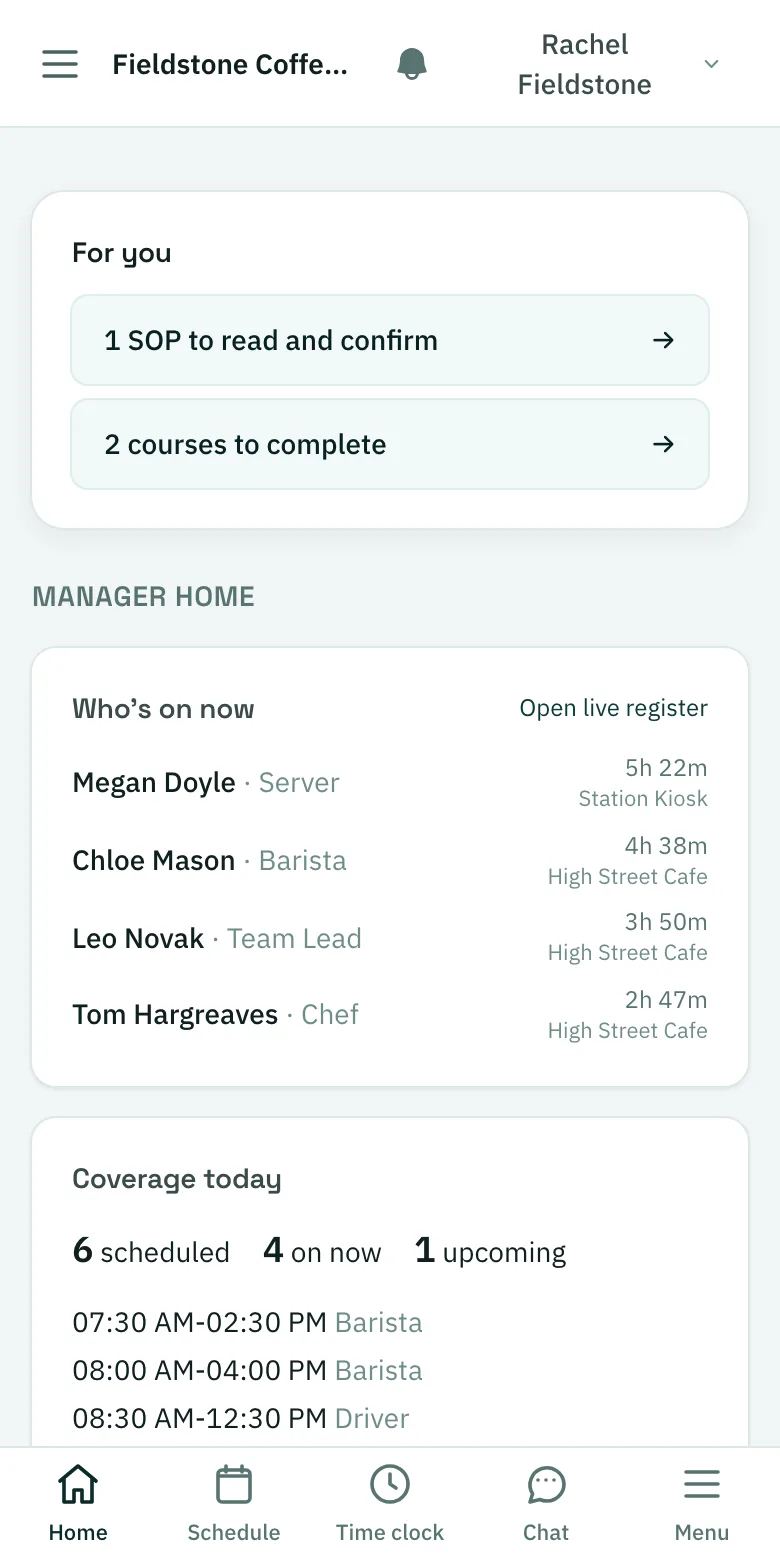
The live register lists who is clocked in and where, and puts an amber marker on any punch that landed away from its site or arrived without a location, with the distance behind it. That is when the flag is worth something: while the person is still on shift and one phone call settles it.
05
No signal is not lost pay
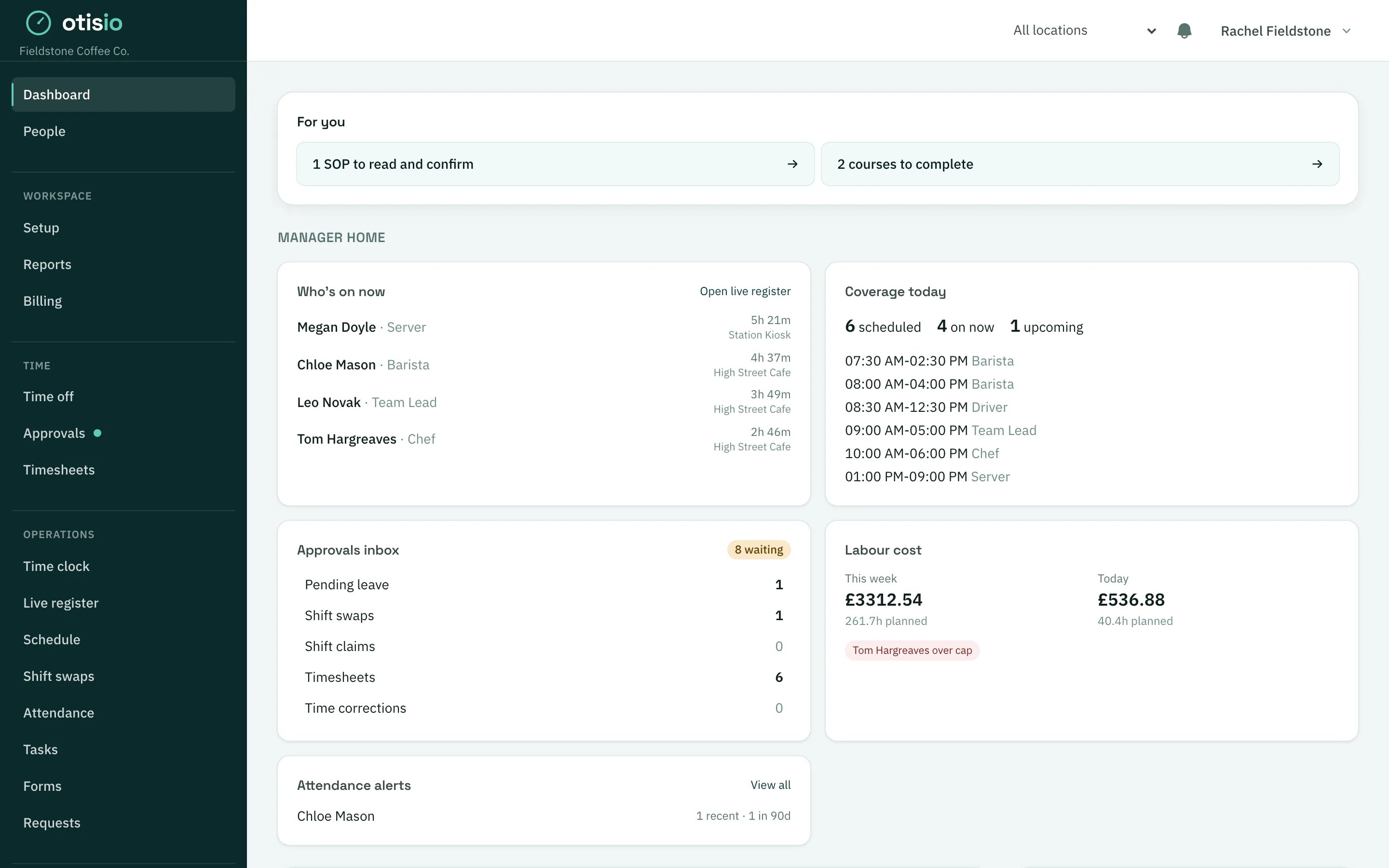
Car parks, basements and rural sites lose signal, and the clock does not. In the staff app and in the web app alike, a punch made offline is kept on the device, replayed when the connection returns, and counted at the time it was tapped rather than the time it synced. Each queued punch carries its own identifier so a replay can never double up, and a punch more than 24 hours old is refused instead of quietly backdated.
06
Where GPS is the wrong tool, the device is the evidence
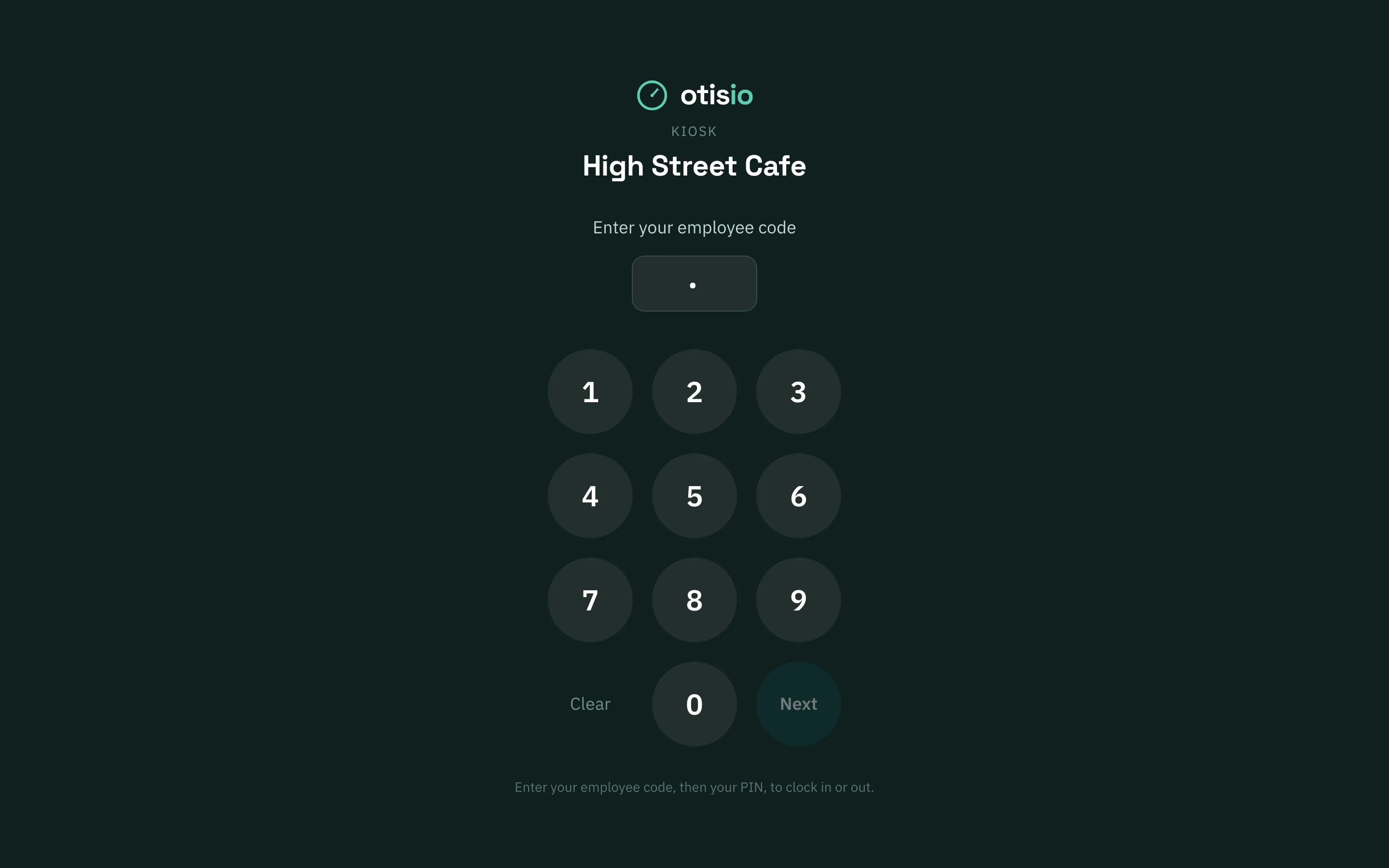
Some punches need no fence because the hardware is already the proof. A kiosk punch on the iPad by the door, a tap on an NFC tag fixed to the wall and a scan of the site poster are all on site by construction, so none of them is measured against a fence, and every one lands on the same timesheet as a phone punch. NFC tag clock-in is on every plan including Free; kiosk mode comes with Pro.
| Location on the punch | Measured against the fence | |
|---|---|---|
| Staff phone, app or browser | Coordinates at the moment of the punch | Yes, at a fenced site |
| iPad kiosk | The site the kiosk is paired to | No: the kiosk is fixed at the site |
| NFC tag tap | The site the tag was written for | No: the tag is fixed at the site |
| Site QR poster | The site the poster was printed for | No: the poster is fixed at the site |
| Desktop app | No coordinates | No |
Small team? It's free. Properly free.
Up to 10 people at one location, with rotas, a time clock, tasks, chat, announcements and time off included. No time limit, no card, and no nagging to upgrade until you actually grow.
Works together with
Questions about gps time clock
How does a GPS time clock work?
Someone clocks in on their phone and the app asks the phone for its position at that moment. The coordinates are stored on the punch alongside the time. Where the site has a fence, the punch is also measured against it, so the record says how far from the site the person was when they clocked in.
Can it stop someone clocking in from home?
Yes, if you want it to. Out of the box an out-of-radius punch is recorded and marked rather than refused. Turn enforcement on for a site and a punch made outside that radius is refused, with the distance shown to the person trying to make it.
How accurate is the location?
It is as accurate as the phone's own position fix, which is stored as reported rather than embellished. That is exactly why the default answer to an out-of-radius punch is a flag for a human rather than a refusal, and why the radius is yours to set: a city-centre unit and a 40-acre yard are not the same problem.
What happens if someone turns location services off?
The punch still happens. It is recorded without coordinates and marked as having no location, and at a fenced site you decide per site what that means: allow it, flag it for review, or refuse it. A clock-out is never refused for a missing location, because leaving somebody stuck on the clock is worse than an unproven punch.
When is location actually read?
At the punch. Once when somebody clocks in and once when they clock out, and each of those two directions is a switch your workspace controls.
Does it work without a signal?
Yes, in the staff app and in the web app. The punch is held on the device with the time it was tapped and syncs on its own when the connection returns. The time that counts is the tap, not the sync, and a punch older than 24 hours is refused rather than backdated.
Is there a clock in app with GPS staff can use on their own phones?
Yes. Staff clock in from the staff app on iPhone or Android, or from the web app in any phone browser, and either way the punch carries the coordinates the phone reported at that moment. The web app needs no app store download, and both hold a punch made with no signal and replay it with the time it was tapped.
What makes an employee time clock app with GPS different from a normal one?
One field on the punch. A normal time clock records who clocked in and when; adding GPS records where as well, which is what turns "I was on site at 07:58" from a claim into a record. Everything after that is the same: the punch becomes a timesheet line, the line is approved, and approved hours export to payroll.
Which is the best time clock app with GPS?
It depends on whether your staff work at fixed sites or move between them, and on whether you need a lane for people without smartphones. There is an honest shortlist of four, including the cases where this is the wrong answer, at /best-time-clock-app-with-gps on this site.
What stops one person clocking in for another?
A phone punch carries its coordinates and, at a fenced site, its distance. A kiosk punch needs a PIN, or a face match where facial recognition has been added, which Enterprise includes and Pro and above can buy. An NFC tag has to be physically tapped at the site. Location alone proves a place and not a person, which is what the kiosk credential is for.
Which plan do I need for GPS?
The time clock itself, NFC tag clock-in included, is on the Free plan for up to 10 people. GPS location stamps start at the Starter plan. Geofencing, the part that measures a punch against a site, comes with Pro alongside kiosk mode. The pricing page carries the full feature-by-plan table.
Do staff have to install an app?
No. The staff app, on the App Store and Google Play, is the fullest version, but the web app runs in any phone browser and installs to the home screen without an app store download, and it queues an offline punch the same way. Staff without smartphones use an iPad kiosk or an NFC tag instead.
See it with your own team
Set up takes minutes: add your people, build a week and publish. Free for 14 days on every paid plan, and free for up to 10 people.
No credit card required.