Best GPS time clocks
The best time clock app with GPS, chosen honestly
There is no single best time clock app with GPS, because the honest answer depends on one thing: whether your staff move between sites or stand at one. Crews that move need a location on the punch and a fence around the site. A team at one fixed address is better served by a kiosk or an NFC tag, which prove the place by being bolted to it. This page shortlists four options for UK teams in 2026, says what each is best at, and says where this platform is the wrong purchase.
No credit card required. Free plan for up to 10 people.
Updated July 2026
01
Start with the question that decides it
Before comparing vendors, answer this: do your people arrive somewhere different most weeks? If yes, GPS earns its money, because the only cheap evidence of where somebody was is the phone in their pocket. If no, a fixed device at the site is stronger evidence than any coordinate, and cheaper to run. Most teams have both kinds of worker, which is why the useful test is whether one system can run both lanes onto one timesheet.
02
For crews that move: a fence and a distance in metres
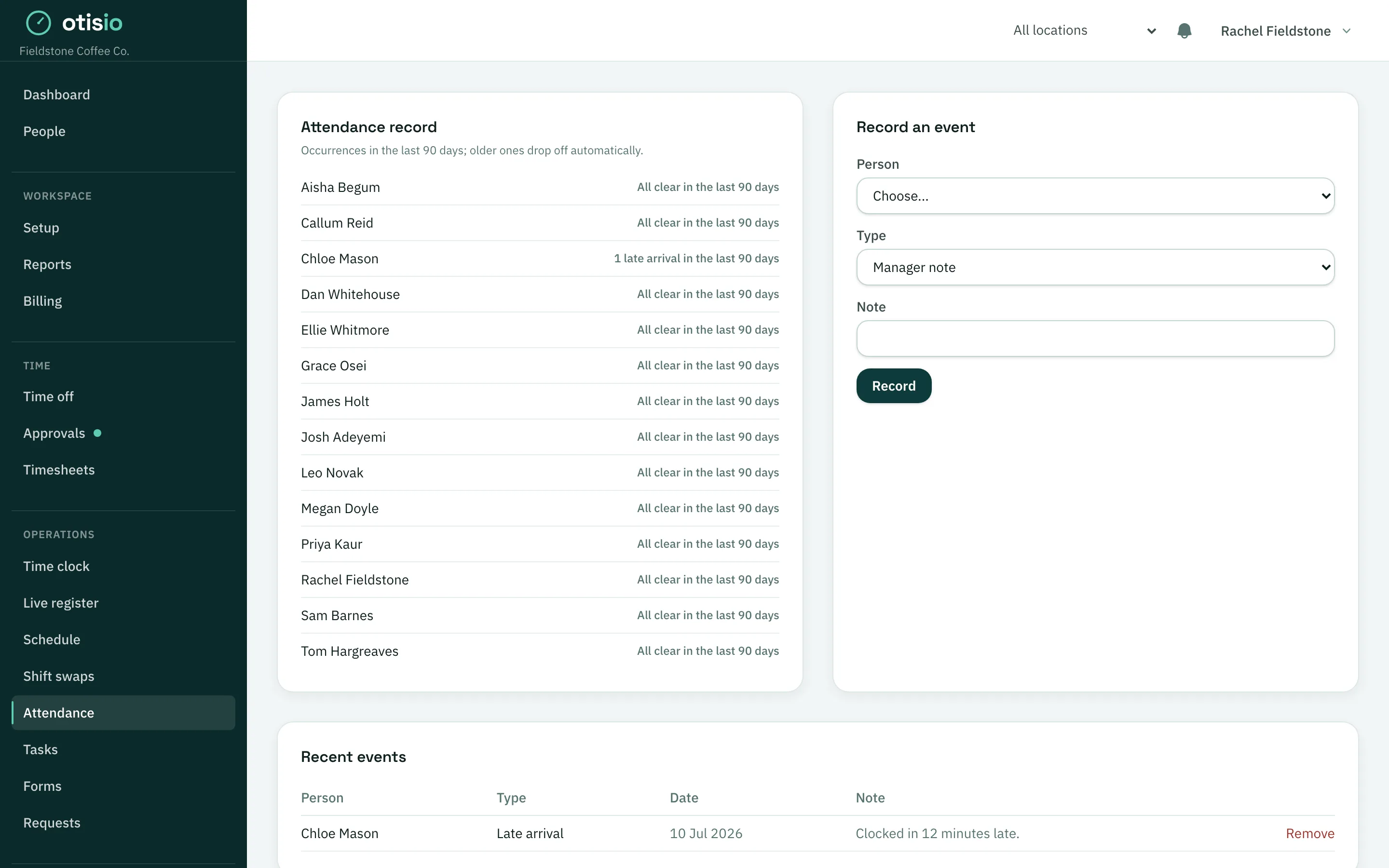
A GPS stamp on its own only tells you a phone reported a position. What makes it usable is a fence around each site and a number: this punch landed 340 metres out. Here a site takes a centre point and a radius between 20 and 5,000 metres, every phone punch is measured against it, and the default is to record and flag rather than refuse, with per-site enforcement available where a harder rule is genuinely wanted. Ask any vendor whether you get the distance or just a red dot.
03
For fixed sites: GPS is the wrong purchase
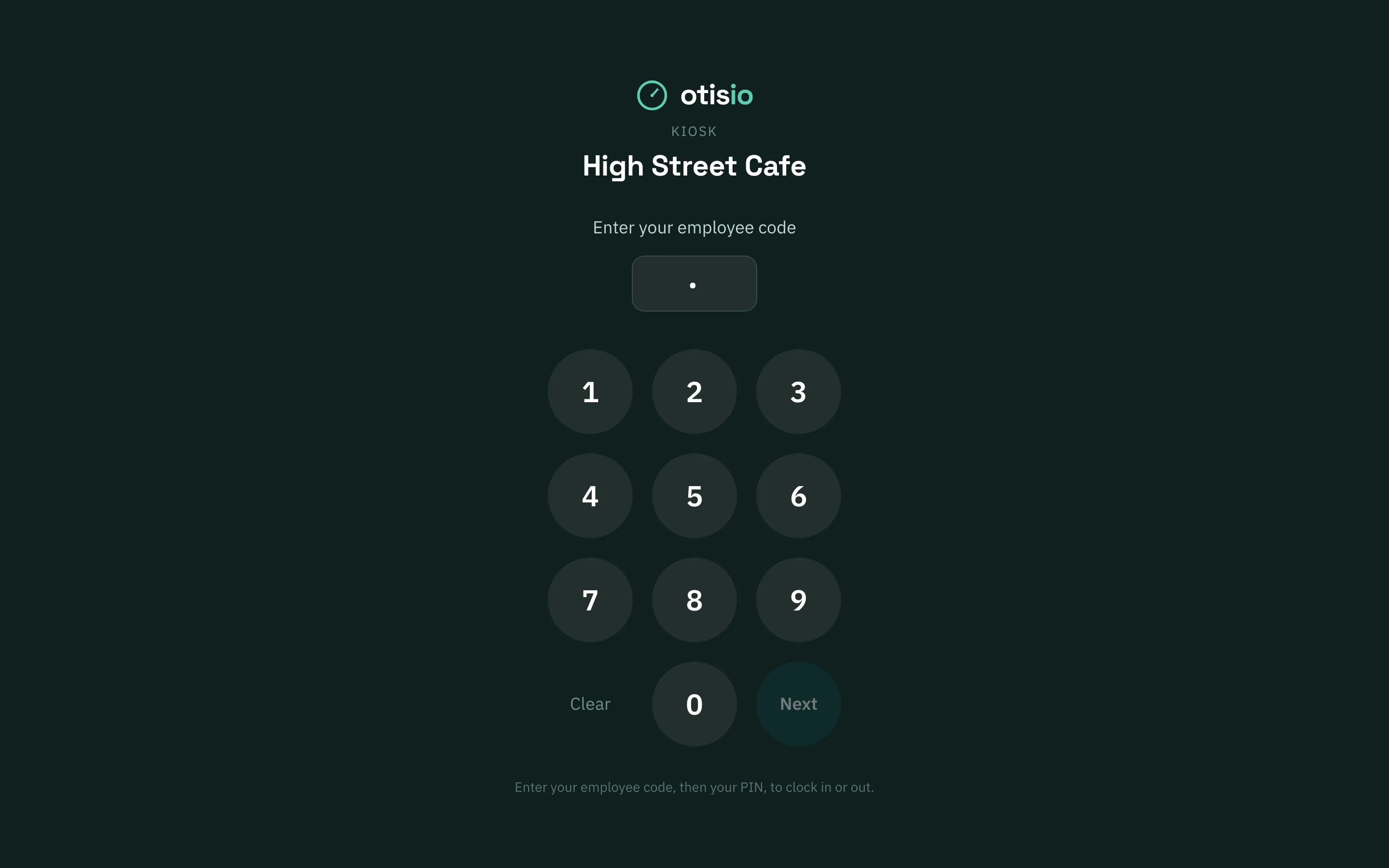
If everyone comes to the same gate, buying a GPS clock is paying for a proof you do not need. An iPad kiosk by the door, an NFC tag on the wall or a printed site QR poster are all on site by construction. They also cover the people GPS never reaches: staff without smartphones, staff who will not install a work app on a personal phone, and agency workers who are gone in a fortnight. NFC tag clock-in is on the free plan here; kiosk mode comes with Pro.
04
Ask what happens when the signal drops
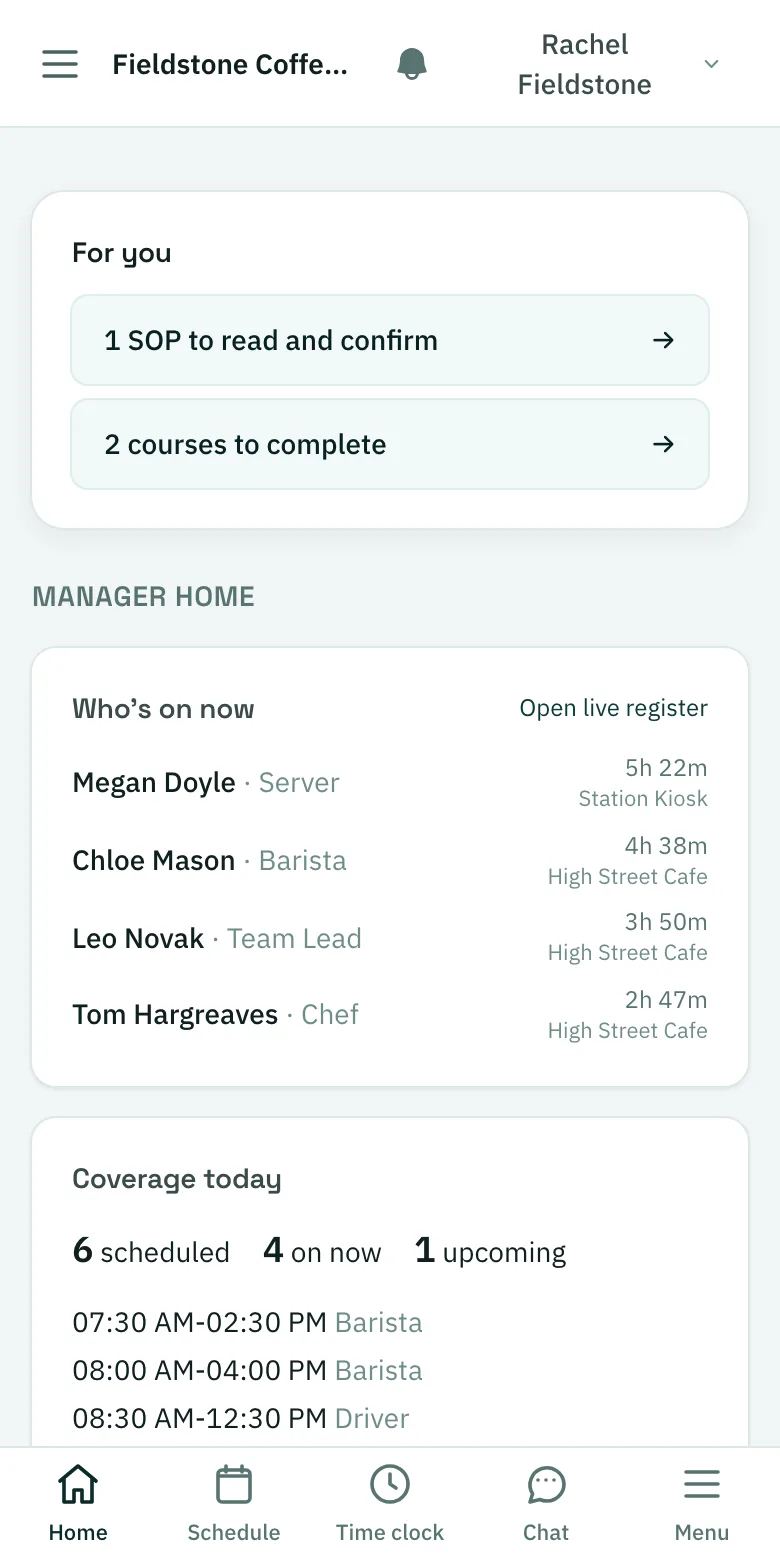
This is the question that separates the shortlist, and it is rarely on a feature grid. Basements, plant rooms, car parks and rural sites lose signal, and a clock that refuses the punch has just created a payroll dispute. Here the punch is held on the device, replayed when the connection returns, and counted at the time it was tapped rather than the time it synced, in the staff app and the web app alike. Each queued punch carries its own identifier so a replay cannot double up, and anything more than 24 hours old is refused rather than quietly backdated.
05
Where this one loses
Three cases where you should buy something else. If you want a permanently free GPS clock, this is not it: the free plan covers up to 10 people with the time clock and NFC tags, and the GPS location stamp starts at the Starter plan, with geofencing at Pro. If you need proprietary rugged hardware wired into site turnstiles, no software-only product answers that, and the construction incumbents do. And the wall-mounted kiosk is an iPad app, so a site that wants a shared clocking-in tablet by the door needs an iPad for it; the staff app itself is on both the App Store and Google Play.
| Best suited to | Free plan | Check this before you buy | |
|---|---|---|---|
| This platform | Multi-site UK teams with agency staff and people without smartphones | Up to 10 people, no time limit, no card | GPS stamps start at Starter and geofencing at Pro, so the free plan is not a free GPS clock |
| Connecteam | Small teams wanting one app for the whole working day | Up to 10 users, as published | Operations, Communications and HR are sold as three separately billed hubs, as published |
| Deputy | Rota-led scheduling in hospitality and retail | None, trial only, as published | Priced per user per month with a UK minimum spend, as published |
| Causeway Donseed | Large construction contractors with a hardware budget | None published | No public pricing at all, quote on request, and the flagship lanes are rugged fingerprint and wall-mounted face units |
Small team? It's free. Properly free.
Up to 10 people at one location, with rotas, a time clock, tasks, chat, announcements and time off included. No time limit, no card, and no nagging to upgrade until you actually grow.
Works together with
Questions about best gps time clocks
What is the best time clock app with GPS?
The one that matches how your staff arrive at work. For crews moving between sites, the best GPS time clock is one that records the coordinates on the punch, measures them against a fence you drew, and gives you the distance in metres rather than a pass or fail. For a team at one fixed address, the best answer is not GPS at all: it is a kiosk, an NFC tag or a QR poster fixed at the site.
Is there a free time clock app with GPS?
Not here, and it is better to know that on this page than after a trial. The free plan covers up to 10 people with the time clock, NFC tag clock-in and timesheets, but the GPS location stamp starts at the Starter plan and geofencing comes with Pro. Several competitors put basic GPS on a free tier, so if free GPS is the requirement, shortlist them instead.
Can a GPS time clock prove someone was on site?
It proves where a phone reported itself to be at the moment of the punch, which is not quite the same thing. That is why a place and a person are two different checks: the coordinates prove the place, and a PIN on a kiosk, or a face match where facial recognition has been added, proves the person. A vendor that says GPS alone stops buddy punching is overselling.
How accurate is GPS clock-in?
It is as accurate as the phone's own position fix, and any honest vendor stores it as reported rather than embellishing it. Urban canyons, thick roofs and cheap handsets all degrade it. That is exactly why the sensible default for an out-of-radius punch is a flag for a human rather than a refusal, and why the radius should be yours to set: a city-centre unit and a 40-acre yard are not the same problem.
What should I look for in a GPS time clock app?
Five things. Whether the location is stored on the punch itself rather than sampled later. Whether you can set the radius per site. Whether an out-of-radius punch is flagged or blocked, and whether that is your choice. What happens to a punch made with no signal. And whether staff without smartphones have a lane that lands on the same timesheet, because in most UK teams somebody does not have one.
Does a GPS time clock work without a signal?
It depends on the product, and it is worth asking directly. Here the punch is held on the device with the time it was tapped, in the staff app and in the web app, and replayed when the connection returns, so the time that counts is the tap rather than the sync.
Is GPS tracking of employees legal in the UK?
Workplace monitoring is lawful only where it is necessary and proportionate, staff have been told clearly what is recorded and why, and a data protection impact assessment has been done for systematic monitoring, which is the Information Commissioner's published position. Recording a location at the moment somebody clocks in is a narrower thing than following a person through the day, which is one reason this clock reads a location at the punch. This is general information rather than legal advice.
Where did the competitor details on this page come from?
From each vendor's own public pages as published in July 2026, and in Causeway Donseed's case from the software directories that list its pricing as available on request. Vendors change their pages, so check before you rely on a figure. Connecteam is a trademark of Connecteam Ltd, Deputy of Deputechnologies Pty Ltd, and Causeway and Donseed of Causeway Technologies Ltd. This page is an independent comparison, and we are not affiliated with, endorsed by or sponsored by any of them.
See it with your own team
Set up takes minutes: add your people, build a week and publish. Free for 14 days on every paid plan, and free for up to 10 people.
No credit card required.